
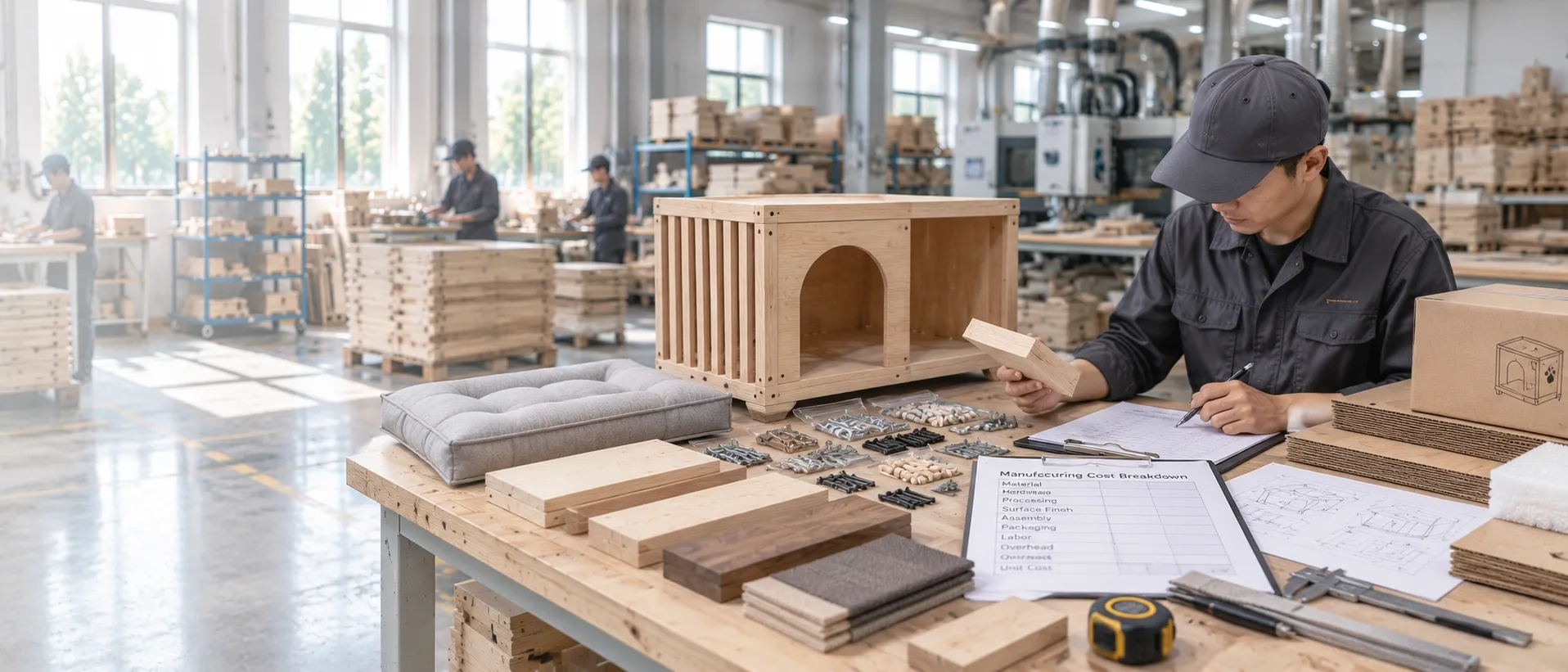
What Does Wooden Pet Furniture Cost to Manufacture?
At 100-500 pieces per design, indicative FOB costs are roughly $6-20 for small accessories and feeders, $22-45 for a standard wooden pet bed, $38-80 for a wardrobe or cabinet, and $45-95 for a carved or canopy bed. Five things move a unit inside those bands: wood species, finish system, fabric, quantity and packaging.
These are budget-checking figures for a standard specification, not a quotation. Full tables and the reasoning behind each driver follow.
Indicative FOB cost by product type
| Product type | Indicative FOB | What moves it inside the band |
|---|---|---|
| Small accessory (hanger set, hair-clip cabinet) | $6–14 | Low material volume; finishing dominates |
| Storage basket / hamper | $9–18 | Fabric liner drives the spread |
| Feeding or water-bottle stand | $10–20 | Small footprint, ceramic/steel bowl not included |
| Pet steps / small climbing shelf | $14–28 | Load-bearing joints, more hardware |
| Standard wooden pet bed | $22–45 | Cushion and cover are 25-35% of cost |
| Carved or canopy bed | $45–95 | Carving is hand-finished; adds labour, not material |
| Wardrobe / cabinet with drawers | $38–80 | Drawer slides and panel area |
| Room divider / folding screen | $30–65 | Panel area and hinge count |
| Solid wood playpen | $42–90 | Large panel area, high shipping volume |
Read these as a sanity check on a budget, not as a price list. A bed quoted at $24 and a bed quoted at $44 are usually not the same product — the difference is almost always in the cushion, the wood species and the number of finishing passes, all of which are visible in a bill of materials and invisible in a price.
Rough cost estimator
Pick a starting point and apply the adjustments. This runs the same arithmetic described in the table below — it is a budgeting aid, and it does not send anything to us.
What the unit price is made of
Before the levers, the blocks. Knowing how large each cost block is tells you where a negotiation can actually reach.
This is why substituting a cheaper timber disappoints: wood is about a quarter of the unit, so a 20% saving on species is roughly 5% on the price. Quantity works better because it spreads the finishing changeover and setup — which sit inside the labour and finishing blocks — across more units.
The five cost drivers, in order of impact
| Driver | Typical swing | Detail |
|---|---|---|
| Wood species | 0 to +35% | Pine is the baseline. Paulownia is similar in cost but lighter, which saves freight. Rubberwood adds 10-15%, beech 20-30%, ash and oak 25-35%. On a bed frame this is usually the second-largest single lever after quantity. |
| Finish system | 0 to +25% | Water-based paint in a single colour is the baseline. A second colour, a glazed or distressed antique effect, or an open-grain oil finish on oak each add a pass through the booth and cure time. E0-grade panels instead of E1 add a small material premium. |
| Fabric and filling | 0 to +40% on upholstered items | On a bed, the cushion can be a third of the cost. Cotton linen is the baseline; velvet and corduroy sit above it. Memory foam roughly doubles the filling cost against PP fibre. Buyer-nominated fabric is quoted at cost plus handling. |
| Quantity | -8% to -22% | Setup, colour matching and finishing changeover are fixed per run. Going from 100 to 500 pcs typically takes 12-18% off the unit price; 500 to 1,000 takes another 5-8%. Beyond about 2,000 pcs per design the curve flattens — material becomes the floor. |
| Packaging | +$0.40 to +$3.50 per unit | A plain brown export carton is the baseline. A printed colour box, foam or moulded pulp inserts, a hang tag, a printed manual and barcode labelling all add. Retail-ready packaging is the most commonly underestimated line in a first quotation. |
Tooling and one-off charges
| Item | Cost |
|---|---|
| Wooden part tooling | No mould cost - solid wood and panel parts are CNC-cut directly from drawings. |
| CNC setup, new design | $0-200 per new design (waived on orders above 300 pcs) |
| Custom metal / die-cast hardware | $300-800 per custom metal or die-cast part |
| Logo printing screen or plate | $50-150 per colour screen or plate for logo printing |
| Sample | $80-350 — sample charges are refunded against the first bulk order of the same design. |
| Third-party test report | Quoted per SKU and per standard; issued in the buyer's name |
The absence of a mould cost is the main structural difference between wooden and plastic pet furniture. It means a new design can be tried at 100 pcs per design without amortising a $5,000-15,000 tool, which is why small brands can develop original designs here rather than only relabelling a catalogue item.
Cost questions, answered directly
How much does it cost to manufacture a wooden pet bed?
At 100-500 pcs, a standard wooden pet bed in pine with a water-based finish and a cotton-linen cushion typically lands at $22-45 FOB per piece. Carved or canopy designs run $45-95. The spread inside each band is driven mostly by the cushion specification and the finish.
Are these prices a quotation?
No. They are indicative FOB bands for a standard specification at the stated quantity, published so you can sanity-check a budget. A real quotation is built from a bill of materials against your drawing, quantity, packaging and destination, and comes back within 24 hours.
What is the single biggest cost lever?
Quantity, followed by wood species. Moving from 100 to 1,000 pieces of one design typically takes 18-25% off the unit price in total — more than any material substitution will give you. If your assortment allows it, consolidating into fewer designs at higher quantities beats negotiating on price.
Is there a tooling or mould cost?
For wooden parts, no — No mould cost - solid wood and panel parts are CNC-cut directly from drawings. CNC setup is $0-200 per new design (waived on orders above 300 pcs). Custom metal or die-cast hardware is $300-800 per custom metal or die-cast part. Logo printing is $50-150 per colour screen or plate for logo printing.
Why is FOB cheaper than the price I see from a trading company?
A trading company adds a margin on top of the factory price, typically 10-25%, and usually cannot change the specification because they do not control the line. Quoting directly means the BOM is visible and a cost reduction can be engineered into the product rather than negotiated out of a margin.
How do I reduce the unit cost without cheapening the product?
Four things work, in order: raise quantity per design; design the part list down (fewer components, fewer hardware types); keep the panel sizes inside standard board dimensions so offcut waste drops; and design for flat packing so freight per unit falls. Freight savings on a bulky item often exceed anything available on the ex-works price.
Does shipping get quoted separately?
Yes. Quotations are EXW Foshan or FOB Guangzhou or FOB Shenzhen by default. CIF and DDP are available on request. Because pet furniture is bulky and light, ocean freight is charged on volume — which is why the knock-down packing decision matters more than it does for dense goods.
Where to go next
CatFurnitureHome production team — Tira Chan, Export Sales Manager, with the workshop supervisors in Lecong Town, Shunde District, Foshan. Last reviewed 2026-09-03. Figures on this page are indicative for standard specifications; confirmed values are issued with your quotation.
Want the real number instead of a band?
Send a drawing or a link to one of our designs with your target quantity, wood species, finish and packaging. You get back a quotation with the bill-of-materials breakdown behind it, within 24 hours.