

How Quality Is Controlled, Stage by Stage
Four inspection stages: IQC on incoming material, IPQC patrol every two hours per line, FQC on 100% of finished units, and OQC sampling on packed cartons at AQL 2.5 major / 4.0 minor / 0 critical under ANSI/ASQ Z1.4 (ISO 2859-1), General Inspection Level II. Load-bearing parts are held at 3x rated capacity for ten minutes, and assembled dimensions are controlled to Plus or minus 2 mm on assembled external dimensions; plus or minus 0.5 mm on drilled hole positions.
Each claim below carries the number and the method behind it, because "we check everything carefully" is not something a buyer can verify or hold us to.
The four stages
-
IQC — Incoming inspection
Moisture content, board thickness, warp, fabric weight and colour against the approved swatch
-
IPQC — In-process patrol
Cut dimensions, joint fit, sanding grit and drill positions - checked every 2 hours per line
-
FQC — Final inspection
100% of units - structural stability, finish defects, hardware count, fitting-bag completeness
-
OQC — Pre-shipment sampling
AQL sampling on packed cartons, carton drop test, labelling and barcode scan
The stage that catches the most problems is IQC, not FQC. Moisture content and board warp are decided before a single part is cut; a panel accepted at 15% moisture will fail in a heated European apartment three months after it passed final inspection in Foshan.
The four claims that matter, and how each is verified
Each block below pairs the number with the method that produces it. Photographs are from the workshop, not stock.
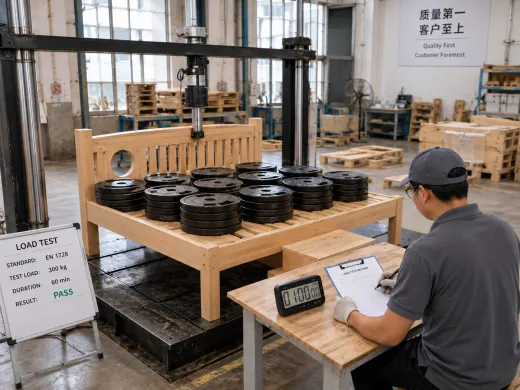
Static load held for 10 minutes on the sleeping surface and on each shelf. A shelf rated for 8 kg is loaded to 24 kg and must show no joint separation and no permanent deflection above 3 mm.
Method · Static load, 10 min hold

Timber is kiln-dried and held at 8-12% moisture content before machining. Above 14% the joints move in dry heated interiors and the finish cracks within one winter.
Method · Pin meter, every incoming timber batch
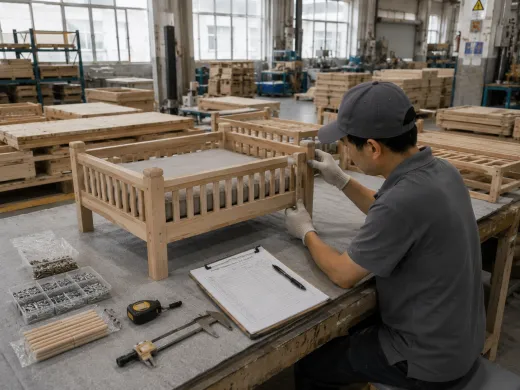
Every unit is checked for structural stability, finish defects, hardware count and fitting-bag completeness before packing. Packed cartons are then sampled at AQL 2.5 major / 4.0 minor.
Method · ANSI/ASQ Z1.4 (ISO 2859-1), General Inspection Level II
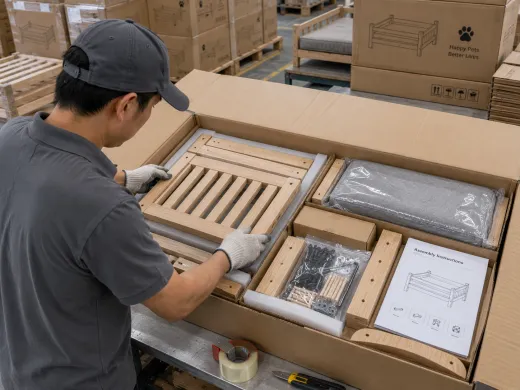
ISTA 1A, 6-face drop from 76 cm on the packed carton, on the packed carton as it will actually ship. A unit that passes every structural test and then arrives damaged is still a failed shipment.
Method · ISTA 1A
Test methods and acceptance criteria
| Property | Method | Criterion |
|---|---|---|
| Load capacity | Static load held for 10 minutes on the sleeping surface and on each shelf | 3x rated capacity; no joint separation, deflection ≤ 3 mm |
| Stability | Tip-over check on a 10-degree inclined plane for every free-standing unit over 600 mm tall. | No tip-over; units over 2,100 mm ship with a wall anchor |
| Moisture content | Pin meter on every incoming timber batch | 8-12% |
| Assembled dimensions | Measured against the approved drawing | Plus or minus 2 mm on assembled external dimensions; plus or minus 0.5 mm on drilled hole positions |
| Finish adhesion | Cross-hatch tape test on a sample from each batch | No coating removal from the cut squares |
| Finish colour | Compared to the signed drawdown under a standard light source | Within the range shown on the golden sample |
| Edge safety | Visual and tactile check on all pet-contact edges | R2 minimum radius, sanded to 240 grit |
| Packaging integrity | ISTA 1A, 6-face drop from 76 cm on the packed carton | No damage to the product; carton may deform |
| Hardware completeness | Fitting bag counted against the BOM on 100% of units | Zero tolerance — a missing screw is a returned unit |
Defect classification
Published so there is no argument later about what counts as a defect. Natural grain and colour variation in solid wood is not a defect — the acceptable range is fixed by the golden sample you signed.
| Finding | Class | Action |
|---|---|---|
| Joint separation under load | Critical | Unit rejected, batch re-inspected 100% |
| Split or crack in a load-bearing member | Critical | Unit rejected, timber batch quarantined |
| Missing or wrong hardware in the fitting bag | Major | Carton reopened, bag replaced, 100% re-check of the batch |
| Finish run, sag or orange peel visible at 500 mm | Major | Unit re-sanded and re-coated |
| Colour deviation beyond the signed drawdown | Major | Batch held, colour re-matched before release |
| Assembled dimension outside ±2 mm | Major | Unit rejected, CNC programme re-verified |
| Sanding mark visible under raking light | Minor | Re-sanded if it affects a visible face |
| Minor colour variation in natural grain | Accepted | Inherent to solid wood; range shown on the golden sample |
Third-party inspection
Buyer-appointed inspection (SGS, BV, Intertek, TUV, QIMA) is accepted at any stage; the factory books the date and provides the packing list.
Book the inspection date at least 5 working days ahead of the scheduled packing completion. Inspections booked after the container is loaded require unloading, which the buyer pays for and which adds 2-3 days.
Certification and product test reports are covered separately on compliance and testing.
Quality control questions
Is every unit inspected, or only a sample?
Both. Every unit passes 100% final inspection (FQC) for structural stability, finish defects, hardware count and fitting-bag completeness. Packed cartons are then sampled at OQC to AQL 2.5 major / 4.0 minor, 0 critical, under ANSI/ASQ Z1.4 (ISO 2859-1), General Inspection Level II.
How is load capacity actually tested?
Static load held for 10 minutes on the sleeping surface and on each shelf, at 3x rated capacity. A shelf rated for 8 kg is loaded to 24 kg and must show no joint separation and no permanent deflection above 3 mm.
What is your dimensional tolerance?
Plus or minus 2 mm on assembled external dimensions; plus or minus 0.5 mm on drilled hole positions. The hole-position tolerance matters more than the external one on knock-down furniture — if drilled positions drift, the customer cannot assemble the unit even though every panel measures correctly on its own.
Can I send my own inspector or book SGS?
Buyer-appointed inspection (SGS, BV, Intertek, TUV, QIMA) is accepted at any stage; the factory books the date and provides the packing list.
How do you stop wood from cracking after delivery?
Timber is kiln-dried and held at 8-12% moisture content before machining. Above 14% the joints move in dry heated interiors and the finish cracks within one winter. This is the single most common failure mode in imported wooden furniture and it is decided at the timber yard, months before assembly — not on the finishing line.
How do you verify the finish colour matches what I approved?
Pantone (TPG / TCX) or a supplied physical chip. A colour drawdown is sent for signature before mass production. The signed drawdown stays at the factory next to the golden sample and every production batch is compared against it under a standard light source before the units are packed.
Is the packaging tested?
Yes. ISTA 1A, 6-face drop from 76 cm on the packed carton, on the packed carton as it will actually ship. A unit that passes every structural test and then arrives damaged is still a failed shipment.
What happens if defects reach me anyway?
Send photographs and the carton labels. The labels identify the production batch and the inspector. Verified defects above the agreed AQL are replaced in the next run or credited against it, and the root cause is fed back into the IQC or IPQC checklist so the same failure does not repeat.
Where to go next
CatFurnitureHome production team — Tira Chan, Export Sales Manager, with the workshop supervisors in Lecong Town, Shunde District, Foshan. Last reviewed 2026-09-03. Figures on this page are indicative for standard specifications; confirmed values are issued with your quotation.
Want the inspection checklist for your product?
Send the design and your market. We return the QC checklist that will be applied to it, the acceptance criteria, and a quotation within 24 hours.